“Not all heroes fight visible battles — some walk the forests daily, preventing disasters the world may never see.”
In the forest landscapes surrounding Tiruvannamalai, the arrival of summer is not sudden—it is gradual, subtle, and deeply telling.
The soil begins to lose moisture.
Vegetation turns brittle.
Streams slow, then disappear.
And with this quiet transformation, a serious risk begins to rise—forest fires. Although the overall annual rainfall in the region appears near-normal, its distribution has been critically uneven. The Northeast monsoon months of November and December—vital for ecological recharge—were significantly weaker in 2025. These months are essential for deep soil moisture retention and groundwater replenishment, particularly in fragile forest ecosystems. Field observations across Annamalai Reserve Forest and Kavuthi Hills clearly indicate abnormal dryness, reinforcing an important reality:
Total annual rainfall alone does not reflect ecological water security. The consequences of this imbalance became visible early.
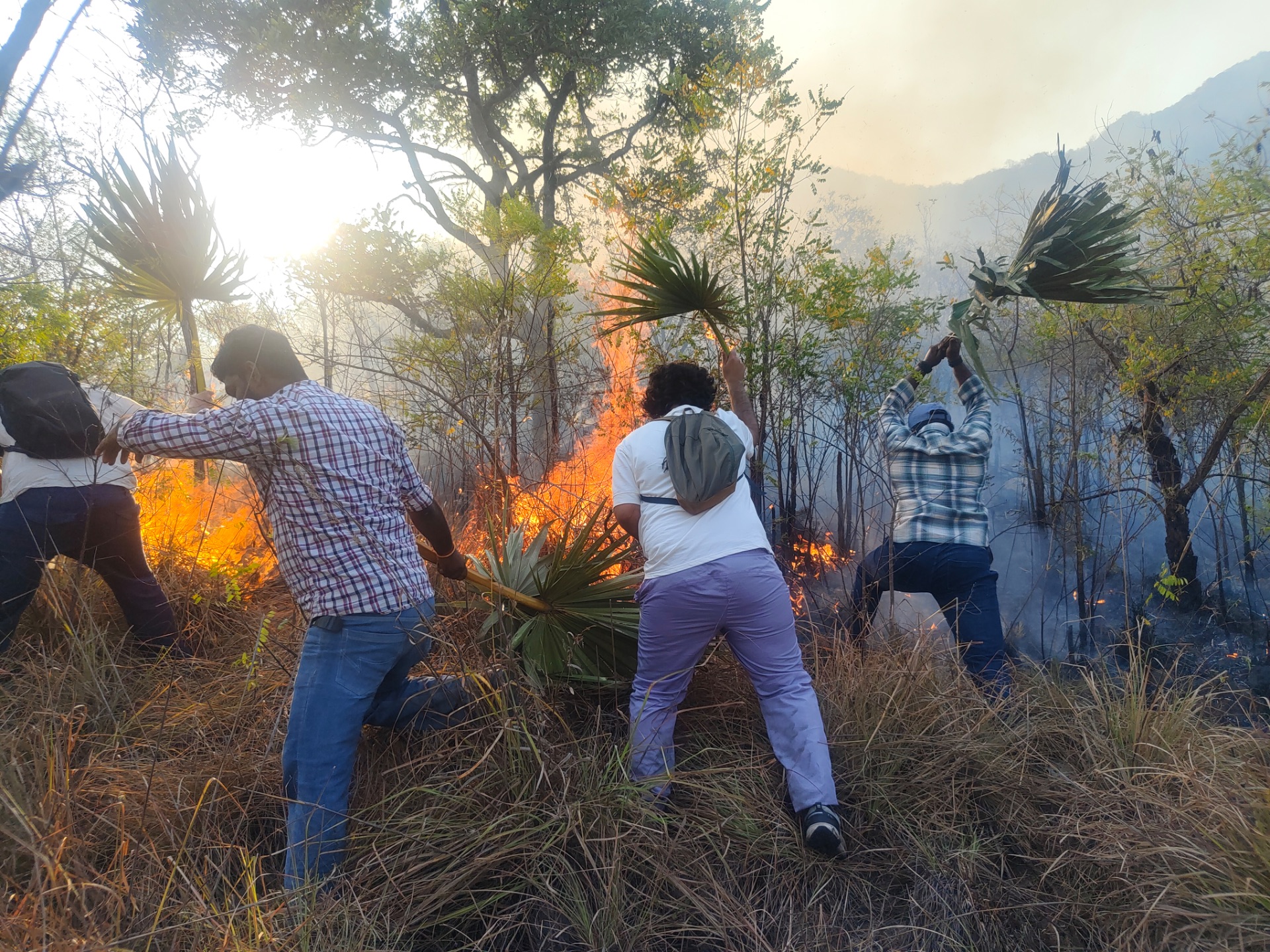
In March, two minor fire incidents were identified and controlled in the Kavuthi Hills region. By April, the situation intensified, with two major forest fires breaking out in the same landscape.
These were not isolated or slow-moving fires. They spread rapidly across dry vegetation, posing a serious threat to biodiversity and forest integrity. The Regenboog team responded immediately.
With preparedness, local knowledge, and coordinated effort, the team successfully contained all four fire incidents, preventing what could have escalated into large-scale ecological damage.
However, this work extends beyond emergency response. Regenboog’s approach is rooted in anticipation and prevention.
Continuous field monitoring, early detection, and rapid response systems form the backbone of this effort. The team remains actively present in the landscape—observing, assessing, and acting before situations worsen.
At the same time, another silent crisis unfolds during summer—water scarcity for wildlife. As natural water sources dry up, animals are forced into distress, often increasing their vulnerability and leading to conflict.
To address this, Regenboog has established water stations across the forest perimeters of Annamalai and Kavuthi Hills. These strategically placed points provide essential hydration support to wildlife during peak summer months, helping sustain biodiversity in these stressed ecosystems.
This integrated effort—fire prevention, rapid response, and ecological support—reflects the depth of field engagement required to protect such landscapes. It is not occasional work.
It is continuous, demanding, and often unseen.
This work would not have been possible without the committed financial support of Accolite Digital India Pvt Ltd, facilitated by Mrs Purnima. Their contribution isn't just funding—it enables timely action, keeps teams on the ground, helps them respond quickly, and supports critical interventions during high-risk periods.
In landscapes where a single spark can alter everything, preparedness becomes protection.
And behind that protection, there is a team that continues to show up—every single day.
This is how the rainbow grows.